
The finding to use
Hand over the evidence and unresolved questions alongside the research draft.
Sources checked 23 November 2026. Follow the reasoning, then use the worksheet for your own situation.
01 / AI in Real Life
Start with the decision the research must support
Imagine receiving a research note with five links and a confident recommendation. The links open, but nobody has recorded which passage supports the deciding claim. You would have to repeat that part of the work. This is a fictional handoff, not a measured study.
Build the checking record while you research.
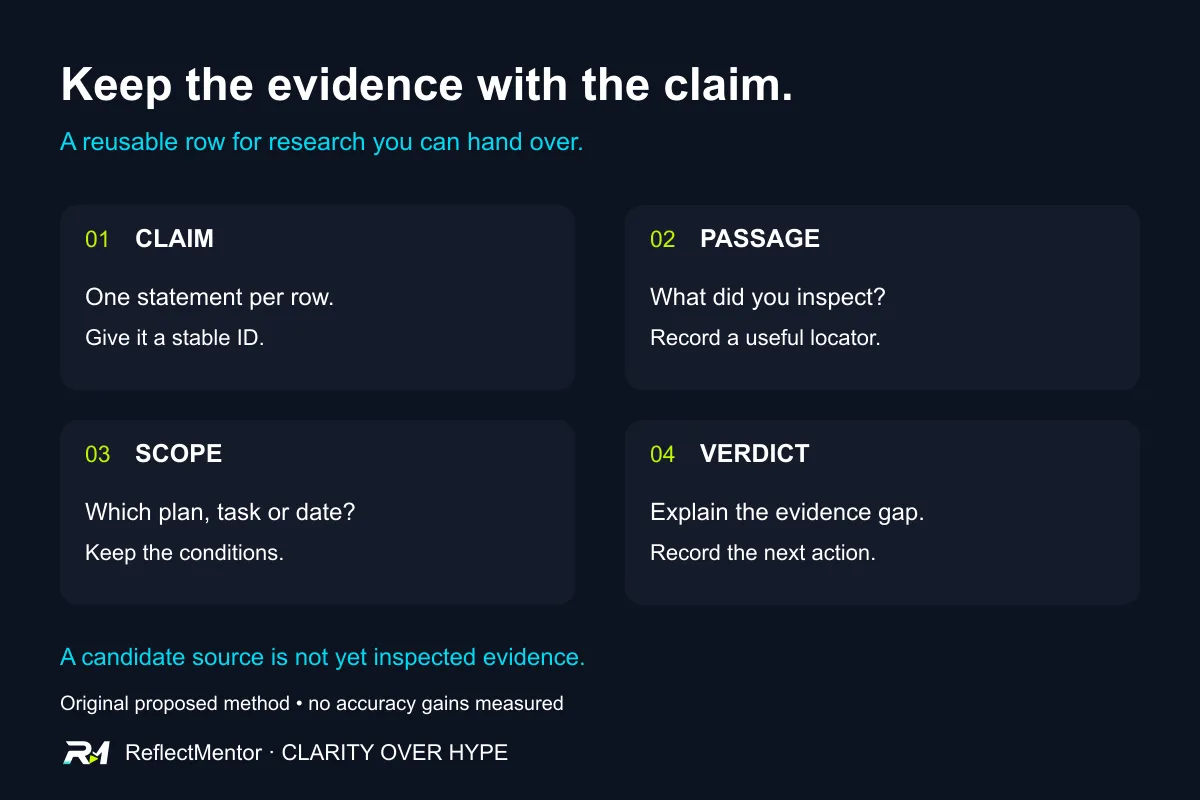
Write one question at the top of the worksheet: what do you need to decide or explain? Then give each important claim its own row. A claim that combines price, compatibility and performance should become separate entries, because evidence for one does not settle the others.
This is a proposed workflow for ordinary research drafts. It supplies a reusable record and a worked example, not a promise that a prompt makes an AI answer accurate.
02 / AI in Real Life
Keep a source lead separate from inspected evidence
Use two stages: candidate source and inspected source. An AI-suggested title starts as a lead. Record its URL or identifier, but leave the evidence fields blank until you can inspect the relevant material.
UBC Library advises checking that AI-provided citations exist and checking the source article for the information attributed to it. [1] These are separate checks. Finding the named paper does not finish the claim review.
Crossref explains that it collects metadata, which may include links to full text. A DOI landing page may contain only basic information and an abstract, and a full-text link does not guarantee access. [2] Record what you actually read: metadata, abstract, a specific section or the full document.
If the needed passage is unavailable, write access gap. Do not describe the full text as checked because its title matches. Use permitted access routes; this worksheet is not an instruction to bypass a login or obtain restricted material.
03 / AI in Real Life
Make each row useful to the next reviewer
Keep the exact claim, source identity, passage locator, scope and verdict together. A locator might be a section heading or page number. Record the publication or revision date when available, plus the date you checked it.
Use a short evidence note in your own words. Preserve conditions that matter: the named product, plan, population, task or time period. If you retain a quotation for private review, keep it limited and follow applicable permissions; the public article need not reproduce the source passage.
Choose a verdict you can explain. Supported means the inspected material supports the claim as written, within the recorded scope. Partly supported means the wording needs narrowing. Not established means the inspected evidence does not settle it. Not checked means the review has not been done.
Not established is not a finding that the claim is false. Add a next action, such as locate the full methods section or verify the current plan documentation. That makes the remaining work visible instead of hiding it inside a confidence label.
04 / AI in Real Life
Try the ledger with one fictional source
Here is an original fictional help note, dated March 2024: Plan P exports project text. Images remain links that require the original account. The note is invented for this exercise and describes no real service.
Row A: Plan P exports project text. The invented note supports that narrow statement for the described plan and document date. Record supported within that scope; availability today is a separate question.
Row B: Every plan exports all project files for offline use. The note does not establish every plan, and its account-dependent images do not support the offline claim. Record not established and narrow the wording before using it.
Row C: This export feature is available today. A March 2024 note alone does not settle current availability. Record current status not checked, with an action to inspect current official documentation. These are worked editorial judgments on invented text, not results from querying an AI model.
05 / AI in Real Life
Use AI to prepare rows, then inspect them yourself
You can try the following proposed extraction prompt with non-sensitive material you are allowed to use. It has not been tested for this guide; its output still needs checking.
Proposed prompt: Work only with the supplied draft and excerpts. Split decision-relevant statements into individual claims. Return a table with claim ID, exact claim, supplied source ID, passage locator if provided, relevant scope, missing evidence and next action. Keep missing fields as not provided. Do not invent source titles, passages, dates or URLs. Leave verification status as not checked for a human reviewer.
Compare each proposed row with the draft and the actual source. Check that the tool has not merged two claims, lost a condition or filled an empty field with plausible wording. The prompt organizes a starting record; the inspected source and your review determine the verdict.
06 / AI in Real Life
Hand off the gaps as clearly as the findings
Before sharing the research, sort the rows by what the decision depends on. Resolve important gaps or state that the conclusion remains provisional. A decorative fact can wait; the claim that decides a purchase or public statement needs its evidence nearby.
Add the reviewer, check date and reason to revisit a row. A changed product version or revised policy is a useful trigger. Keep the old note when a conclusion changes so another reviewer can see what was checked earlier.
Download the worksheet and complete one real claim before adding more. Hand over the unresolved rows with the draft. The next reader should be able to see what you know, where you found it and what still needs checking.
Reusable AI research evidence ledger — fictional worked rows and one blank row
| Claim ID | Exact claim | Source / access / locator | Evidence and scope | Source / check dates | Verdict | Next action / owner |
|---|---|---|---|---|---|---|
| A — fictional | Plan P exports project text | Original fictional help note / full excerpt / Plan P sentence | Text export only, for named plan and note date | Invented March 2024 note; worked example only | Supported within fictional scope | Check current availability separately |
| B — fictional | Every plan exports all files for offline use | Same fictional excerpt / images sentence | Every plan not established; images require original account | Invented March 2024 note; worked example only | Not established | Narrow the claim before reuse |
| C — fictional | The feature is available today | Same fictional excerpt / dated note | Old note does not establish current status | Invented March 2024 note; worked example only | Not checked for current availability | Find current official documentation |
| YOUR-01 | Not checked |
Sources & revision note
Primary sources checked 2026-11-23. Practical frameworks are editorial guidance; illustrative examples are not measured results.
- UBC Library: Evaluating information from generative AI — check citations and attributed claims
- Crossref: Accessing full texts — metadata, DOI landing pages and access limits
Revision 1 · 2026-11-23: First publication: reusable research ledger, original three-row fictional example, proposed extraction prompt and conceptual diagram.
Keep the useful part
Take the decision back to your work.
Hand over the evidence and unresolved questions alongside the research draft.
This preference is private to this browser, not a public vote count.