
The finding to use
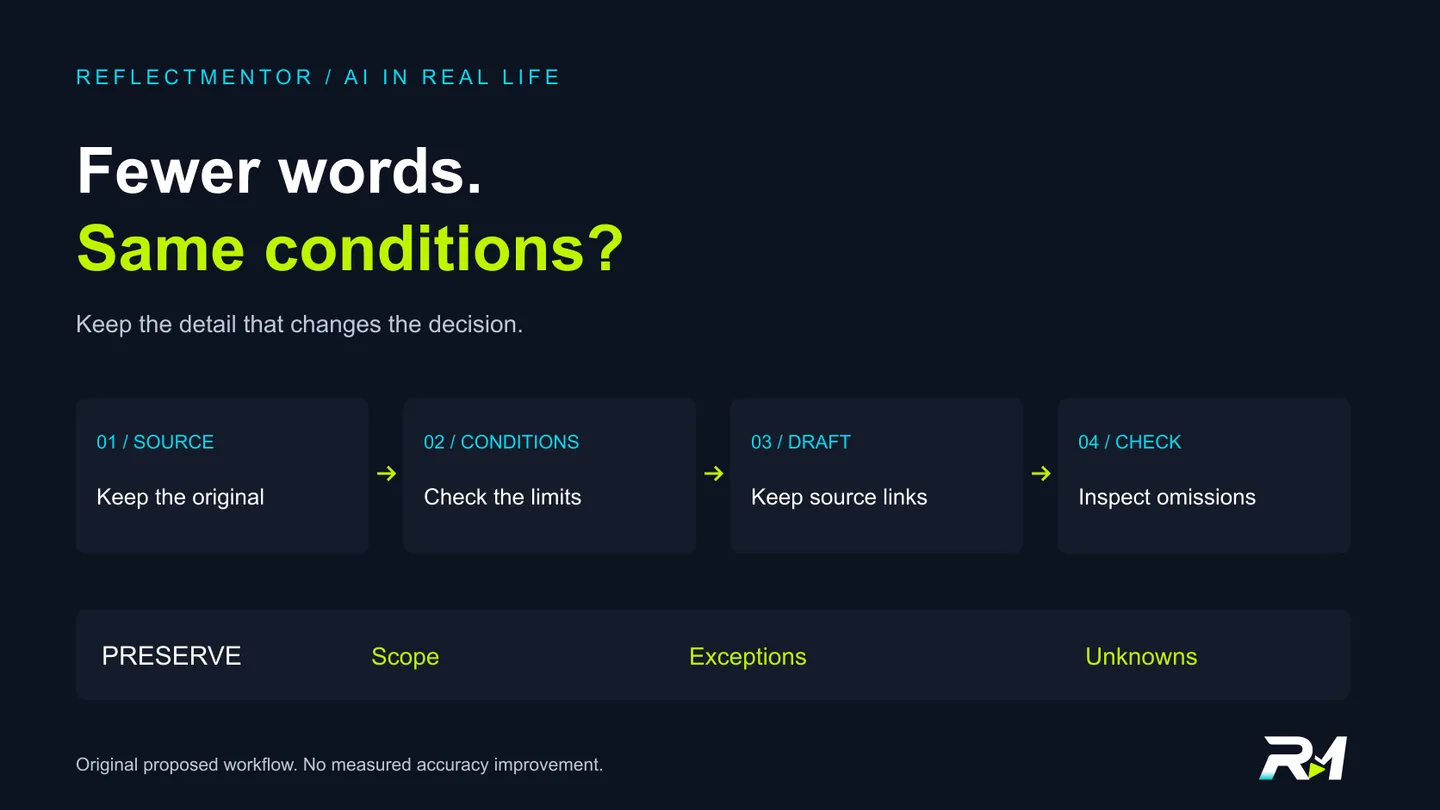
Check the exceptions before you share the summary.
Sources checked 18 November 2026. Follow the reasoning, then use the worksheet for your own situation.
01 / AI in Real Life
Choose what the summary must preserve
A document says a pilot may start after budget approval. The summary says the pilot starts next month. The second sentence is shorter, but it has turned a condition into a commitment. This is an invented example, not a result from testing an AI tool.
Decide what the reader needs before asking for fewer words.
For a project brief, that may mean the proposed work, who it covers, prerequisites, exclusions and unresolved decisions. Write those requirements down. If an exception would change what someone does next, it belongs in the brief for the summary.
Maynez and colleagues' 2020 study found content unsupported by the input in the summarization systems they evaluated. [1] That is a reason to inspect source support, not a current error-rate estimate for every assistant. A fluent sentence still needs to match the document you supplied.
02 / AI in Real Life
Use a small fictional document to see the problem
Here is our original practice text. It is deliberately short enough to inspect without a tool. The dates describe a fictional proposal, not an actual event or policy.
[A] A training pilot is proposed for 1–30 June. [B] Participation is limited to the support team. [C] The pilot may begin only after the manager approves its budget. [D] Contractors are excluded. [E] The review date has not been set.
An illustrative bad summary would say: Training starts on 1 June for all staff, with a review at the end of June. We wrote that sentence to expose the errors. It is not a captured model response.
Our expected summary is: A training pilot is proposed for 1–30 June for the support team, excluding contractors. It can begin only after the manager approves its budget. The review date is unset.
Compare the two versions against A–E. The bad version loses the proposal status, widens participation, drops approval and invents a review date. The expected version keeps those decision-relevant limits. This comparison is a manual editorial illustration; it does not establish that a particular prompt will make a model produce the expected answer.
03 / AI in Real Life
Extract a conditions ledger before drafting
Use documents you are allowed to share with the chosen tool. Keep a stable copy with its title, date and version. Number paragraphs or retain section labels so that an output can point to a location you can open again.
Try this proposed first prompt: Use only the document below. Before writing a summary, list its main claims, who or what each covers, conditions, exceptions, dates and unresolved questions. For each row, give the source paragraph or section and a short supporting passage. Keep proposed, may, only after and excluded meanings intact. Mark missing information as not stated. Do not fill gaps from general knowledge.
Read that ledger yourself. Check every supporting passage against the original, including whether the surrounding paragraph changes its meaning. A generated passage reference is something to verify, not proof that the row is correct.
In the fictional example, the ledger must keep the pilot window separate from the unset review date. It should also keep approval as a dependency. Do not compress those fields into a single timeline just because that looks tidier.
04 / AI in Real Life
Draft the short version from checked rows
Once you have checked the ledger, define the audience and length. A manager deciding whether to approve a pilot needs different detail from a participant checking eligibility. Neither brief should silently replace a proposal with an announcement.
Try this proposed second prompt: Using only the checked ledger and source document, write a brief summary for the stated audience. Preserve conditions that affect the decision, exclusions, uncertainty and unresolved dates. Keep a source-location reference beside each factual sentence. If the length limit would remove an important condition, flag the conflict instead of deleting the condition. Return any statements whose support is unclear in a separate needs-checking list.
A short word limit is a preference, not permission to change the meaning.
Keep the references while reviewing. You can choose a cleaner reading format later, but retain the checked source map beside the final summary. If you revise the wording, check that sentence again; the earlier check covered the earlier wording.
05 / AI in Real Life
Check omissions as well as invented claims
For each summary sentence, open its supporting passage. Check actor, scope, numbers, dates and strength of claim. Then work in the other direction: inspect the source's conditions and exclusions and ask whether any missing detail changes the reader's likely action.
For our fictional pilot, a summary can contain only statements found in the document and still be misleading if it omits the approval requirement. Sentence support and decision completeness are separate review questions.
Keep the original open during this pass.
Liu and colleagues' 2024 long-context study examined question answering and key-value retrieval. Performance varied with where relevant information appeared in the tested contexts. [2] It was not a summary-quality test of every current product. Our practical inference is to avoid treating a successful large-file upload as evidence that every exception has been preserved.
For a longer document, you can review sections individually and keep a combined exceptions list, then check cross-references against the full source. That is a proposed organizational method, not a proven fix. A heading, footnote or later qualification can still change how a passage should be read.
06 / AI in Real Life
Share the checked version with its limits
Record the source version and review date. Name what the summary covers, and leave unresolved items visible. If you could not inspect an appendix or confirm a passage, mark that gap instead of implying complete coverage.
Use the worksheet below as a review record. It is not a reliability certificate, and we have not measured accuracy gains or time savings from this workflow. Asking the same assistant whether its summary is correct does not replace opening the source.
Before sharing, ask one concrete question: did any shorter sentence change who qualifies, what is promised or what must happen first?
Source-to-summary review worksheet
| Check | Record from the source | Review question |
|---|---|---|
| Source identity | Document title, version, date and inspected sections | Is the summary tied to this exact source? |
| Claim status | Proposed, conditional, approved or otherwise qualified wording | Did the draft turn a possibility into a commitment? |
| Scope | People, teams, products, locations or situations covered | Did the draft widen or narrow the audience? |
| Conditions and exclusions | Dependencies, only-if clauses, exceptions and cross-references | Would an omission change the reader's action? |
| Dates and unknowns | Separate dates by purpose; keep not-stated fields visible | Did the draft merge dates or invent a missing answer? |
| Sentence support | Summary sentence, source location and checked passage | Does the passage support the wording in context? |
| Final review | Reviewer, review date and unresolved gaps | What remains unchecked before sharing? |
Sources & revision note
Primary sources checked 2026-11-18. Practical frameworks are editorial guidance; illustrative examples are not measured results.
- Maynez et al. (ACL 2020): On Faithfulness and Factuality in Abstractive Summarization
- Liu et al. (TACL 2024): Lost in the Middle: How Language Models Use Long Contexts
Revision 1 · 2026-11-18: First publication: source-to-summary workflow, two proposed prompts, fictional worked example and caveat-checking worksheet.
Keep the useful part
Take the decision back to your work.
Check the exceptions before you share the summary.
This preference is private to this browser, not a public vote count.