
The finding to use
Use the score to shortlist a tool; use a checked work sample to decide.
Sources checked 16 November 2026. Follow the reasoning, then use the worksheet for your own situation.
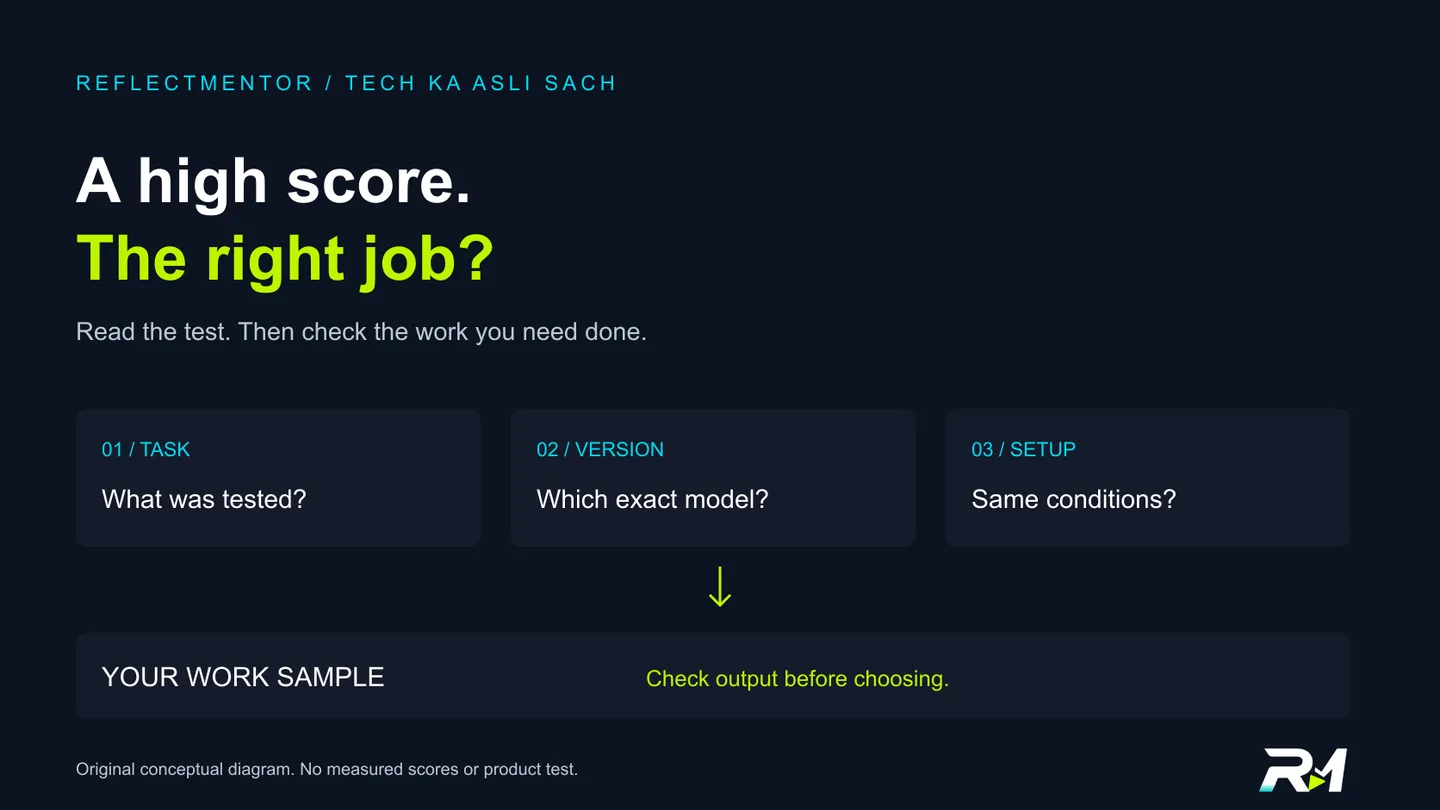
01 / Tech Ka Asli Sach
Start with the job behind the score
Imagine you need an assistant to turn messy meeting notes into an action list. A product page points to a high score on an exam-style benchmark. That result gives you something to investigate. It does not show whether the assistant will preserve an uncertain deadline or leave a missing owner blank.
The useful question is narrower than which model is smartest. What did this test ask the model to do, and how close is that to your work?
The original MMLU paper describes a test covering 57 tasks, including mathematics and computer science. [1] Its published scope gives you a starting point for checking relevance. Answering academic questions is a different task from producing a checked action list. That difference is a reason to inspect fit, not a reason to dismiss the test.
Write your actual job in one sentence before opening another ranking: turn these notes into owners, actions and deadlines, with missing information clearly marked. Now you have something concrete against which to read the claim.
02 / Tech Ka Asli Sach
Read the method before comparing the bars
Find the benchmark name, model identifier, evaluation date and method. Record what you cannot find. A screenshot with two bars and no method is not enough to establish a fair comparison.
The original HELM framework calls for controlled comparisons and measurement across more than one metric. Its 2022 introduction also explains that prompting and adaptation can affect results. [2] Those are methodological points; the old model rankings in that introduction are not a current buying guide.
Ask whether the compared results use the same task set, scoring rule and prompting procedure. Check whether tools, retrieved information or multiple attempts are part of the test. If one result reports a different setup, keep it in a separate row until you can explain the difference.
For example, suppose one demonstration allows web research and another provides only a pasted document. Treat that as a proposed comparison of two workflows, not evidence that the underlying models were tested under identical conditions. No such experiment was run for this guide.
03 / Tech Ka Asli Sach
Check which model and which product you can use
Copy the exact tested model name or version into your worksheet. Then check what the product you would buy actually provides. If the seller does not establish a match, mark it unknown rather than assuming that a similar name guarantees the same setup.
A subscription decision also needs product-level checks: access limits, available tools, document handling, export options and relevant data controls. Verify these in the current plan documentation. We have not compared any provider's current plans or prices here.
Consider a student who needs to process a particular document format. A benchmark result cannot answer whether that format works within the plan they can afford. That is a separate requirement to verify before purchase.
04 / Tech Ka Asli Sach
Choose more than one way to judge success
An overall score may answer a narrower question than the one on your checklist. In its original evaluation, HELM considered accuracy alongside calibration, robustness, fairness, bias, toxicity and efficiency. [2] You do not need to reproduce that research to notice when a buying decision has several requirements.
For the meeting-notes example, define success as correct actions, visible unknowns and no invented commitments. Keep checking time and output quality in separate columns. An answer that looks tidy but needs every date repaired has not met the brief.
Choose the checks before looking at the outputs. Otherwise, it is easy to reward whichever answer has the most polished layout. Your criteria should describe a usable result, not a preferred writing style alone.
05 / Tech Ka Asli Sach
Run a small comparison you can inspect
Use a few non-sensitive examples that resemble your work. Include an ordinary case, an ambiguous case and one where the input lacks information. This is our proposed screening exercise, not a validated benchmark or proof of general reliability.
For a meeting-notes task, write down the expected actions and the deliberately missing details first. Give each candidate the same instructions and input, then record the product, selected model, date, settings and tools used. Preserve the output so you can compare it with your expected result.
Inspect each action against the notes. Did the assistant retain the caveat? Did it invent an owner? How much correction was needed before the list could be shared? If a trial is not available within your existing access, keep that candidate untested. Do not pay just to complete a comparison table.
A small sample leaves plenty unknown. It can expose a mismatch in the work you inspected; it cannot establish that a model will behave the same way on every future task.
06 / Tech Ka Asli Sach
Make a decision you can explain later
Keep three outcomes available: suitable for this checked use, unsuitable for this use, or not established. That last category prevents a missing test from quietly becoming a recommendation.
Use the worksheet below to separate the published benchmark claim from your own observations. Date both. If the model or product changes, you will know which parts of the decision need another check.
Our buying judgment is to use benchmarks as shortlist evidence, then verify the particular work, product constraints and costs that matter to you. This guide does not name a winning model or recommend a subscription.
Before your next renewal, pick one real task and write down what a correct result must preserve. The next score you read will have a much clearer job to do.
Benchmark-to-buying decision worksheet
| Check | Record | Decision limit |
|---|---|---|
| My job | Input, expected output and missing-information rules | A different benchmark task does not establish this workflow's fit |
| Published claim | Benchmark URL, task, metric and evaluation date | Missing method stays unknown |
| Model and setup | Exact version, prompts, tools and attempts, where documented | Different setups need separate comparison rows |
| Product access | Current plan documentation and required features | A model score does not establish plan eligibility |
| Checked work sample | Expected answer, actual output, errors and correction time | A small sample does not prove general reliability |
| Verdict | Suitable for this use / unsuitable / not established; date | No invented score or untested recommendation |
Sources & revision note
Primary sources checked 2026-11-16. Practical frameworks are editorial guidance; illustrative examples are not measured results.
- Hendrycks et al.: Measuring Massive Multitask Language Understanding (2020; revised 2021)
- Stanford CRFM: original HELM framework (2022) — metrics, standardization and adaptation
Revision 1 · 2026-11-16: First publication: benchmark interpretation checklist, comparison worksheet and primary-source methodology links.
Keep the useful part
Take the decision back to your work.
Use the score to shortlist a tool; use a checked work sample to decide.
This preference is private to this browser, not a public vote count.